
REVIEW · LAS VEGAS STRIP TOURS
Las Vegas Strip Self-Guided Walking Audio Tour
The Strip can feel loud and random, not now. This self-guided Las Vegas Strip audio walk gives you offline maps and hands-free audio that plays automatically as you reach each story stop. It is a simple way to turn the busy sidewalk into a guided tour, without paying for a bus or matching someone else’s schedule.
I especially like the practical setup, download the route once on strong signal, then keep going without cellular stress. I also like the lifetime access style, no expiry, so you can replay pieces on another trip. One thing to consider: the route is over 4 miles and can run 1 to 2 hours, so you need good walking shoes, and if you start away from the intended beginning you may miss some audio or fight the timing cues.
Key points to know before you go
- Offline maps and auto-play audio mean you do not have to keep checking your phone every few steps
- Over 35 audio stories on a roughly 4+ mile route gives you plenty to listen to
- Lifetime access with no expiry so you can use it again on a future Vegas visit
- Hands-free, start and pause anytime works well for breaks, photos, and detours
- Headphones matter for clear audio on a noisy Strip sidewalk
- Weather-friendly pacing lets you keep moving at your own speed and duck into entrances when needed
How the audio tour works on the Strip (offline, GPS, and hands-free cues)
This is not a map-only app. The point is that the audio plays on its own when your phone detects you are at the next location on the route. That is the big win, because you can keep your eyes up for signs, buildings, and street views, instead of constantly opening your phone.
To make it work offline, you have to download the maps and the tour content while you have strong wifi or cellular. After that, you can keep listening even if service drops. Your download is tied to a specific setup in Action’s Tour Guide app, plus a password you receive by email and text after booking. The practical message here is boring but important: do the download before you fully commit to walking.
Because the audio triggers by location, staying close to the tour route helps. If you wander far off, audio timing can get weird. And if you skip the intended start point, you might lose part of the experience. That flexibility is nice for choosing a starting direction, but the tour is designed as a linked chain of stories.
For audio quality, plan on using headphones or earbuds. The Strip is loud, and wind can mess with speaker volume. Quiet listening is the difference between enjoying the narration and feeling like you are fighting your phone.
Price and time: does $14.99 per person feel worth it?
At $14.99 per person, this lands in the range of a casual add-on, not a full-day guided tour. The value improves if you travel with someone and can share a single tour audio stream, for example by splitting headphones. The tour also emphasizes buying per vehicle or party rather than per person in how people often use it, which can help you keep costs down when you are walking as a pair.
Time is the other piece of value. You should plan for about 1 to 2 hours, and the route length is over 4 miles with more than 35 story stops. That is long enough that you will feel it in your calves if you are not used to the Strip pace. But it is also short enough to still enjoy a full Vegas day, especially if you pair it with lunch and photos rather than squeezing it between nonstop activities.
Compared with a bus or a guided group, you get two things you usually cannot buy:
- Your own pace. Stop for a closer look at a sculpture, then walk on when you are ready.
- A repeatable tour. Lifetime access means you can come back later, replay the parts you liked, or use the audio while doing a second pass at night.
If you hate long walks or you only want a quick hits version, this might feel like too much work. But if you enjoy people watching, big architecture, and explanations that actually connect the dots, it is a good deal for the price.
You can also read our reviews of more walking tours in Las Vegas
Stop 1: Leo the Lion at MGM Grand, the 50-ton cold open
The tour starts at Tropicana Las Vegas, a DoubleTree by Hilton, at 3801 Las Vegas Blvd S. From there, you head to the first audio story point. The narration begins when you are in the right place.
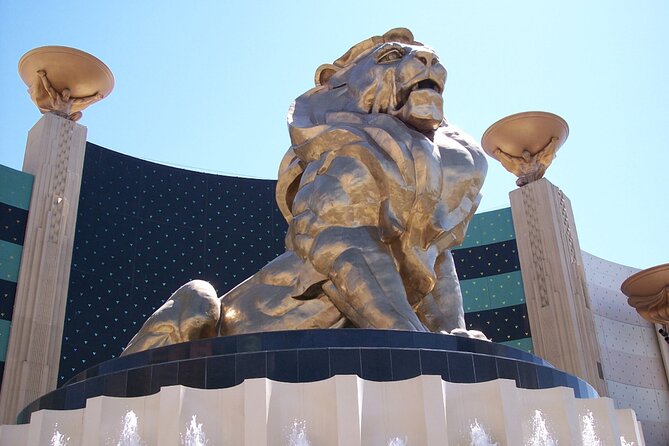
Your first real wow moment is Leo the Lion, the enormous golden MGM Grand lion. This sculpture is 45 feet tall and weighs around 50 tons, and it is one of the largest bronze sculptures in the United States. The story behind him matters, because Leo was the live action icon roaring from the Metro-Goldwyn-Mayer logo during film openings from 1957 until 2021. The tour also notes that the newer logo is CGI, but still mirrors Leo’s look and that famous roar.
Why this is a smart opening: Leo is instantly recognizable, even for first-time visitors. You get a memorable landmark, plus a culture hook, instead of starting with something generic. It sets the tone for the rest of the walk, where each resort is tied to a specific idea, era, or branding move.
Practical tip: stand a moment and look around before you move on. MGM’s facade, signage, and nearby towers give you a lot to see, and you will be glad you did not rush at the start.
The Strip is not Las Vegas: Paradise to the MGM Grand casino
After Leo, the audio shifts into a quick city geography lesson. The Strip is not technically inside Las Vegas city limits. It runs through an unincorporated town called Paradise, and it was not incorporated until 1950. It is one of those facts that makes the whole area feel slightly different, like you are walking through a planned stage set rather than one unified city.
Then you transition into MGM Grand proper. The narration calls out that the casino debuted its new location here in 1993, during a period of major development. The MGM Grand hotel is also a number you will remember, 6,852 rooms, which the tour frames as the third largest in the world. Even if you do not care about room counts, that statistic gives you a scale reference for how Vegas works, giant spaces built for constant motion.
This part of the walk is useful even if you are not a casino person, because it explains why these buildings feel so intense. They are designed like destinations, not just places to gamble.
Planet Hollywood and Paris replicas: when Vegas wears costumes
As you keep moving, you hit Planet Hollywood Resort and Casino. It has been operating since 2007, and the site previously held the Aladdin casino from 1966 until 1997. That is a common Vegas pattern, old space reused for a new brand. The tour helps you see those transitions rather than treating every building as if it arrived fresh.
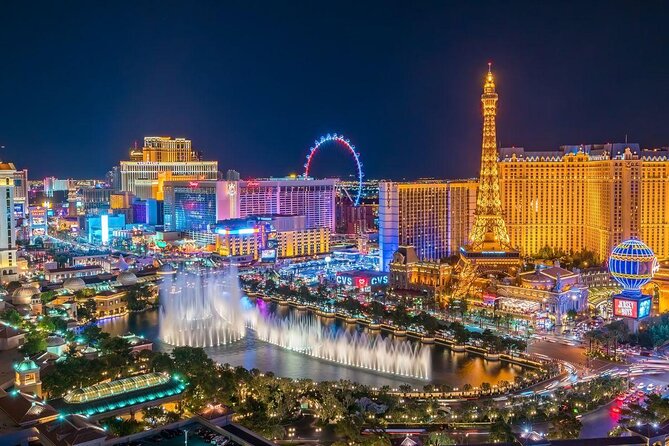
Then comes Paris, Las Vegas. Here you get a version of France with Eiffel Tower and Arc de Triomphe replicas, plus a La Fontaine des Mers style centerpiece. The facade pulls together elements associated with the Louvre, Musee d’Orsay, and the Paris Opera House. The narration credits Catherine Deneuve as a brainchild behind the concept, and it says the property opened in 1999.
This segment is where the audio tour becomes fun for photo lovers. You will likely notice how the lighting and sightlines are built to sell an illusion. Even if you know these are replicas, the stories give you context for why Vegas copies what it copies.
If you want one practical strategy: take a slow moment at each major entrance. The audio is short at each stop, and stepping back lets you take in the overall design rather than only reading signage.
Horseshoe, Flamingo, and Harrah’s: the older Vegas soul
The tour continues with Horseshoe Las Vegas, which opened in 2023 on the former site of Bally’s Las Vegas, and before that, the old MGM Grand. The name ties to Binion’s Horseshoe on Fremont Street, nicknamed Glitter Gulch, where Benny Binion ran it for nearly 40 years. Horseshoe is basically a branding bridge, old-school casino identity moved onto the Strip.
Next is Flamingo Hotel and Casino, opened in 1946. The tour calls it the oldest continuously operating resort on the Strip, and it frames the property as the model for later high-end Vegas resorts that defined the city in the 1950s and 1960s. The narration also highlights the Art Deco architecture that evoked Miami Beach, and the way the resort treated guests with opulence during an era when Vegas still felt rough.
One of the most specific details here is about dealer rules: Flamingo dealers wore white suits and tails, and players were asked to remove their hats in the casino. You do not have to agree with the vibe to appreciate the old etiquette, it is a window into how Vegas tried to look respectable while staying unmistakably Vegas.
Then you reach Harrah’s Las Vegas, at its current spot since 1992. The audio notes that for 20 years before that, the site held the Holiday Inn and Casino, one of the few casinos run by a woman at the time. That kind of detail makes the walk feel more grounded, like you are reading the city’s behind-the-scenes timeline.
You can also read our reviews of more guided tours in Las Vegas


Venetian, Mirage, and Caesars: big branding, business drama, and union ties
The Venetian comes next. The narration notes it used to be the Sand Resort, which was a favorite haunt of Frank Sinatra and his Rat Pack. That is the Vegas mix in a sentence: celebrity culture, themed design, and branding that makes you feel like you are part of a story.
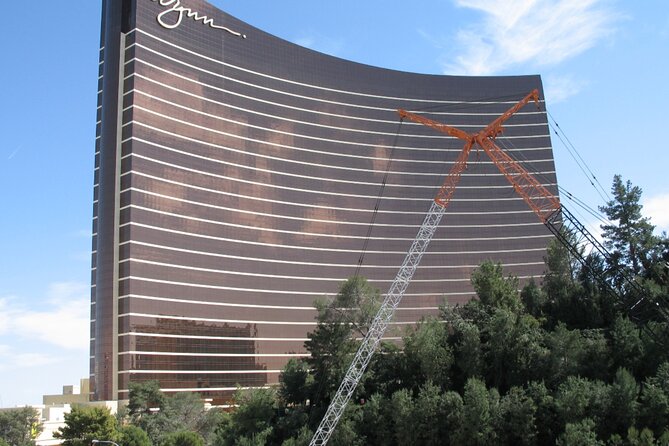
Then the audio pivots to The Mirage. The tour describes how the resort’s look in 1989 offered a glimpse into the city’s future. It also includes a twist in the funding story. Michael Milken funded the construction by selling $525 million in bonds. Eight months before The Mirage opened, Milken was indicted on 98 counts of racketeering and securities fraud. The tour adds that owner Steve Wynn still credited him, with Wynn saying that Mike changed things, No Mike, no Mirage. Whether you treat this as a cautionary business tale or a fun Vegas footnote, it adds color.
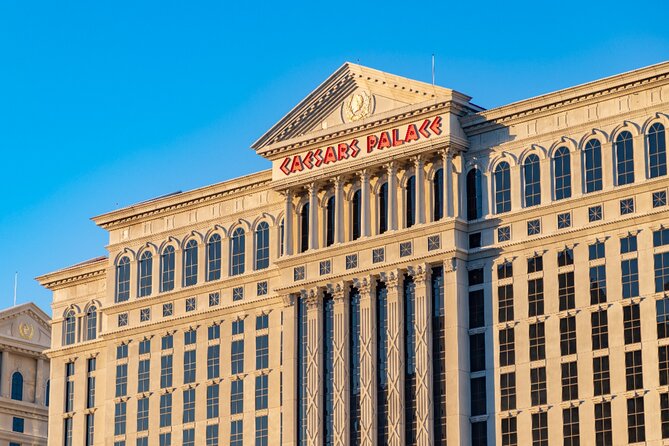
After that, Caesars Palace appears. The tour says Caesars has thrived here since 1966, and it mentions the grand opening guest list included Jimmy Hoffa, president of the Teamsters. The narration frames him as a union slash crime boss who helped fund the resort construction. Vegas and power circles have always been linked in complicated ways, and this stop gives you that connection without over-explaining.
Bellagio, ARIA, and CityCenter: tech, scale, and the Strip’s biggest indoor stage
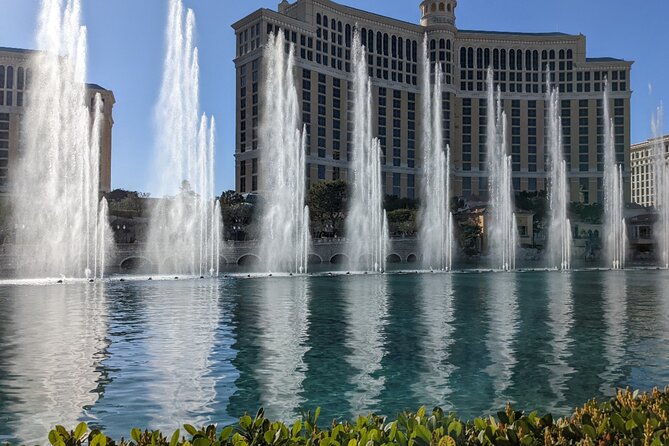
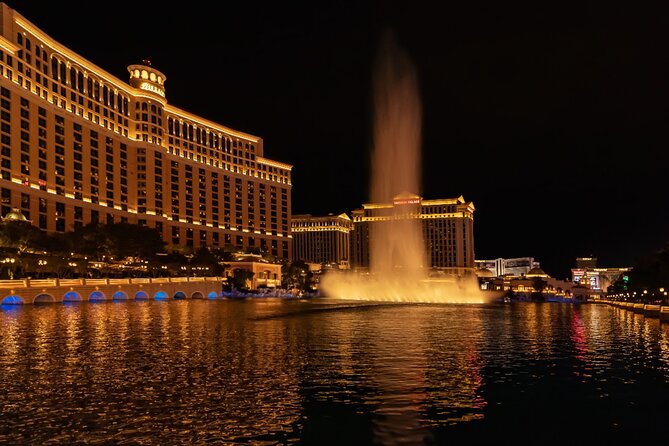
Bellagio opens the next wave of modern glam. The tour says it opened in 1998 and explains its name came from a village on Lake Como in northern Italy. It adds a design story too: Steve Wynn initially proposed building a 50-acre lake on the site, with an island in the middle for a French-Alpine themed resort that was to be named Beau Rivage. Then Wynn and his wife took a vacation to Lake Como, and that is what shaped the final name.
Bellagio is also a good walking pause point. Even if you do not plan to watch shows, you can use the stop to orient yourself, because the resort layout and entrances help you navigate the rest of the Strip section.
Next is ARIA Resort and Casino, opened in 2009. The tour emphasizes how it tried to modernize Vegas with technology. Rooms respond as soon as you enter: curtains open, TV and lights turn on, music starts, and climate controls kick in. When you leave, the room shuts itself down to conserve power, all without switching anything manually. That is a clear contrast to the older casinos, and it explains why ARIA feels like the future.
Then you hit CityCenter, described as the ARIA Campus, a multi-use complex that includes ARIA, Waldorf Astoria, Vdara, Veer Towers, The Shops at Crystals, and a large shopping mall. If you like architecture and planning, this is a “walk slowly and take it in” segment.
You also pass Waldorf Astoria, but the audio clarifies it is the Vegas recreation. It also brings in a historical note about the New York flagship, mentioning everything from Frank Costello to Fulgencio Batista as figures associated with it. It is a reminder that Vegas borrows legitimacy from famous brands, then recreates them at Strip scale.
Park MGM, New York-New York, Excalibur, Luxor: theme parks you can walk through
Park MGM is next, described as having the only totally smoke-free casino on the Strip. The tour frames it as a bigger and more modern MGM resort, but one without the older MGM Grand history. If you care about comfort, smoke policies are a practical detail, and it shapes how long you can comfortably spend inside.
Then the audio takes you to New York-New York. It opened in 1997, and it replicates a block of Manhattan skyline and landmarks using facade design. The tour lists examples like the Lever House, Empire State Building, and other NYC building references, plus additional facade elements like Liberty Plaza and the New Yorker Hotel. It also mentions the casino frontage features fiberglass replicas linked to famous NYC scenes and icons, including the New York Public Library, Statue of Liberty, Ellis Island, Grand Central Terminal, and the Brooklyn Bridge. This is the Strip’s theme park mindset in full display.
The tour adds one real-world note during this stretch: a major stamp scandal in 2010 connected to this themed design. That is the kind of odd trivia that makes the walk feel less like pure sightseeing and more like learning the quirks of how Vegas operates.
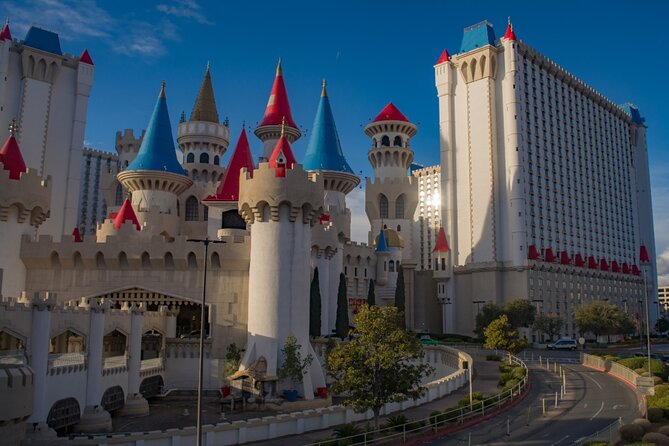
After New York-New York, Excalibur appears with its cartoonish castle facade named for King Arthur’s sword. Rumors about the castle being torn down have circulated, according to the audio, but the tour labels that as unverified.
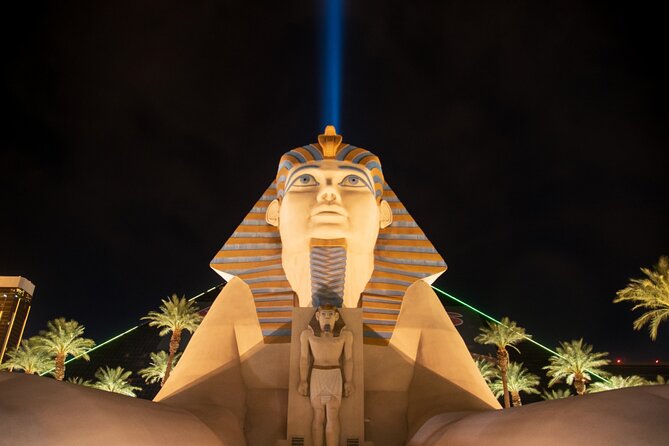
Then the route reaches Luxor Hotel and Casino, which opened in 1993. The narration notes it is named for an ancient Egyptian city and that it has lost some luster. Still, the Luxor Sky Beam is called out as the big feature, shooting upward from the pyramid top and visible from anywhere in the Las Vegas Valley. If you have never seen it in person, this is the kind of thing that makes you feel like Vegas is basically a giant set with a spotlight.
Mandalay Bay: the finish line with a naming mystery
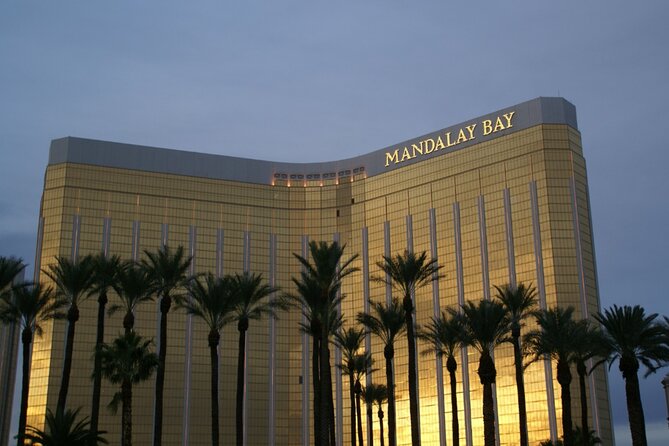
The tour ends in the Mandalay Bay area. It opened in 1999, and early development names included Project Paradise. The narration says ownership tested dozens of other names before settling on Mandalay Bay. It also gives a geography fact: Mandalay is the second largest city in Myanmar, on the bank of the Irrawaddy River, but it is hundreds of miles from the nearest bay.
That name mismatch is the point. The audio raises the question, why call it Mandalay Bay when it is not near a bay. You get a satisfying sense that Vegas branding is often about sound, rhythm, and recognition as much as literal accuracy.
The tour finishes back at the Tropicana Las Vegas meeting point. You can start and pause whenever you like in the app, so you can save the final stretch for when you are ready rather than treating it like a strict time trial.
What kind of traveler should book this?
Book it if you want a self-paced way to understand the Strip’s transformations. It fits best if you enjoy stories tied to specific places, like why a resort exists, what it replaced, and how the names and themes connect to broader Vegas branding.
Also book it if you like flexibility. You can pause for photos, step into entrances when the weather turns, and resume without guilt. One review note that you can take seriously: on rainy days, the Strip layout gives plenty of chances to shelter while still continuing the walk.
Skip it if your priority is a short walk. Over 4 miles plus 1 to 2 hours listening time is a commitment, and no audio app will make that distance feel effortless. And if you do not want to manage a phone download day, you might find the offline requirement annoying. That offline setup is the heart of the value, but it means doing one thing up front.
Should you book this Las Vegas Strip self-guided audio tour?
Yes, if you like structure without babysitting. The combination of offline maps, auto-playing stories by location, and lifetime access makes it a low-cost way to turn a first or second Strip walk into something more memorable.
My call hinges on one practical point: you are willing to walk more than 4 miles and you will wear headphones. If you can do that, $14.99 is a fair price for a couple hours of guided storytelling across major icons.
If you hate long walks, or if you plan to start wherever is convenient and ignore the tour’s location cues, consider a shorter or more flexible approach. This one works best when you follow the route like a route.
FAQ
Is this tour self-guided or do I meet someone?
This is self-guided. No one meets you at the start. You go to the first story point and the audio begins automatically, then continues as you reach the next destinations.
How long does the Las Vegas Strip audio walk take?
It is designed for about 1 to 2 hours.
How much does it cost?
The price is $14.99 per person.
Do I need internet or cellular service while I walk?
You can avoid cellular use. You download maps so it works offline after download, but you must download the tour while you have strong wifi or cellular connectivity.
Will the audio play automatically?
Yes. The audio stories play on their own based on your location as you reach each destination.
Where does the tour start and end?
It starts at Tropicana Las Vegas, a DoubleTree by Hilton Hotel at 3801 Las Vegas Blvd S, Las Vegas, NV 89109, USA. It ends back at the meeting point.
What language is offered?
The tour is offered in English.
What phone or tablet do I need?
The recommended setup is an iPhone running iOS 15 or later, an Android device running version 9 or later, or an iPad or tablet with GPS and cellular connectivity for navigation.
What should I bring?
Bring headphones or earbuds for the best experience.
What is the cancellation policy?
You can cancel for free up to 24 hours in advance for a full refund. Cancellation within 24 hours is not refundable.
More Walking Tours in Las Vegas


More Tours in Las Vegas



More Tour Reviews in Las Vegas
Not for you? Here's more nearby things to do in Las Vegas we have reviewed




More Las Vegas Strip Tours
 ★ 4.6Las Vegas Strip: The High Roller at The LINQ TicketFrom $284,266 reviews
 ★ 5.0The Strip’s Celebrity Chefs Tour or Downtown Food TourFrom $1301,704 reviews
 ★ 4.6Night Helicopter Flight over Las Vegas StripFrom $1241,566 reviews
 ★ 4.7Helicopter Night Flight over the StripFrom $991,565 reviews
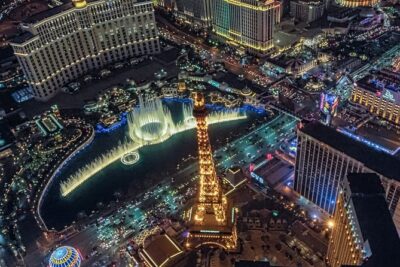 ★ 4.5Las Vegas Strip Helicopter Night FlightFrom $991,487 reviews
 ★ 5.0Taste the Vegas Strip: A Local’s Food Tour ExperienceFrom $124469 reviews
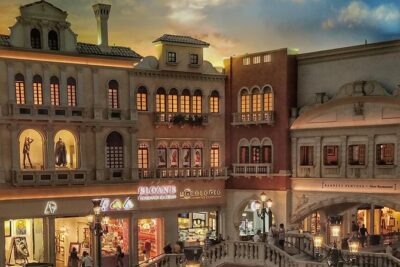 ★ 5.0Must-See Spots Vegas Strip Walking TourFrom $49384 reviews
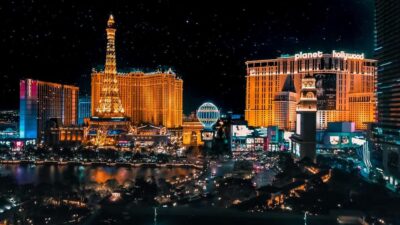 ★ 4.8Helicopter Tour of the Strip with Window SeatsFrom $105357 reviews
More ways to spend the day