REVIEW · WALKING TOURS
Red Light District & Fremont Street Walking Tour, Las Vegas
Sin City has a past, and Fremont shows it.
This walking tour strings together the old downtown Vegas that most people only glance at, then connects it to the era of legal prostitution and how it was shut down. You’ll hit classic Fremont Street landmarks and casino interiors tied to famous moments, plus photo stops and story beats that explain how the city became what it is today.
I especially like two things here. First, the pace is built around short, casino-to-casino visits that keep the walk lively without dragging you into long lines or ticket booths. Second, the guide’s storywork is supported by recreated visuals you can access in the app, including proprietary videos that bring historical moments back to life as you stand in the right spot.
The main downside is also part of the fun: Fremont Street is loud, and it can be hard to catch every word over music, crowds, and casino noise. If you’re sensitive to sound, plan to take a few seconds to angle toward your guide at each stop, and consider bringing headphones so you can follow along if that option is offered.
Key things I’d mark on your mental map

- Small group scale: capped at 10 travelers, so you are not lost in a crowd.
- Free entry stops: most locations on the route include admission tickets at no extra cost.
- AI-supported storytelling on-site: app-access videos and photo recreations tied to specific landmarks.
- Big photo moments: Vegas Vic, “firsts” at Golden Gate, and iconic downtown photo positioning.
- The Red Light District takedown story: Mrs. Roosevelt’s visit, the role of Hoover Dam, and how brothels lost their ground.
- A strong finish with next-step ideas: you wrap near Container Park and get suggestions for what to do afterward.
Starting Point on Fremont: get oriented fast

The tour begins at Carousel Bar inside the downtown area near Carousel Bar1 S Main St. This is a solid choice because it gets you into the Fremont Street flow right away. You are not stuck walking miles to “the real action,” and you start with a straightforward goal: learn how downtown Vegas formed, then trace how the city moved past the Red Light District.
Expect an intro from your in-person guide, then the walk begins with a quick orientation of what you will see. Because the group is small, you can ask practical questions while the route is still forming in your head. That matters later when the story turns darker and more detailed, because you will know why each stop connects.
Time-wise, plan on about 1 hour 40 minutes to 2 hours. Most stops run in the 5 to 15 minute range, which keeps it snappy but still gives you moments to look around and take photos.
You can also read our reviews of more walking tours in Las Vegas
Fremont Street Experience: where downtown Vegas really started
The first stop is the Fremont Street Experience, described as the gateway to Fremont Street West, historic Vegas, old Vegas, and the origins of Sin City. This is the kind of spot where you can do two things at once: soak in the sights and get a mental framework for the rest of the route.
At this early stage, you are not learning every detail yet. Instead, your guide sets up what downtown represented in the early days, how it became a magnet for gamblers and showpeople, and why this specific corridor became the city’s stage.
One practical tip: if you want good photos, arrive ready for crowds. Even if the tour keeps moving, Fremont is a magnet. Your best chances are usually right after the guide points out where to stand and what angle to try.
Plaza Hotel Casino: the 1905 auction story in a modern setting

Next you head to a casino stop at the Plaza Hotel. The big draw here is the canopy location of a famous auction in 1905, and the idea that the tour shows you what happened through recreated visuals accessible via the app.
What I like about this stop is the way it bridges eras. You’re in a casino today, but you are being asked to look at it like an observer in the past, when auctions and development decisions helped shape what Vegas would become. The guide also links the site to how those early business moments influenced the city’s future.
This is one of those stops where listening matters almost as much as looking. If you only glance around, you miss the point. If you pay attention for a few minutes, you’ll understand why downtown’s growth was so fast and why these buildings still carry weight.
Main Street Station: antiques, a piece of the Berlin Wall, and early slots

At Main Street Station, you step into an elegant casino environment and walk through a private collection of antiques from around the world. The headline items to watch for are a piece of the Berlin Wall and some of the earliest slot machines ever made.
I love stops like this because they change the way you experience a casino. Instead of thinking only about games, you notice the objects as museum pieces. The tour frames the visit as being transported back to a high-end parlor home, which is exactly how the room design can feel when you slow down and look at details.
One caution: because the stories are specific, it helps to stay close to your guide during the interesting parts. Casinos can pull your attention away fast, and the whole point here is to connect what you’re seeing with why it matters.
Circa Resort and the “Glitter Gulch” photo zone

The next key stop is Circa Resort & Casino, which is treated as the newest jewel on Fremont and tied to the first “Strip” called Glitter Gulch. That alone is a fun contrast, because Circa feels modern and polished compared to the older downtown casinos nearby.
Circa also gives you a lot of recognizable Vegas energy: the largest sports book in the world, a very long bar in Nevada, and 120 beer taps. You can also get a strong photo moment here, which is part of why Circa is called out specifically.
Then the guide adds a darker layer through a story about prohibition. The tour notes that this is home to the last bar to open before prohibition ended, a detail that pulls the narrative from flashy present-day Vegas into the messier politics that almost hurt the city.
If you’re a photo person, this is one of the stops to treat like a “stand and aim” moment. Let the guide tell you where to place yourself, then take your shots quickly before the crowd shifts.
Golden Gate Hotel: firsts, one-way mirrors, and Rat Pack vibes

At the Golden Gate Hotel, the tour focuses on a curated journey through what’s described as the very first Vegas hotel and its famous “firsts.” You’ll hear about the original “eye in the sky,” one-way mirrors, and early artifacts like the first telephone, ledgers, and gaming chips. You can also sample a drink from the Rat Pack Bar.
This is another stop where context makes the photos better. The building is historically flavored, but you’ll get more out of it if you listen for what each artifact represents in the evolution of the city’s nightlife and gaming culture.
I also appreciate that the tour doesn’t treat Golden Gate like a random casino interior. The guide points to specific features you can recognize, so you leave knowing why it’s famous rather than just having a nice postcard.
Vegas Vic: the moving cowboy and the story behind the changes

You’ll then see Vegas Vic, the moving cowboy that is listed in the Guinness Book of World Records. The guide explains multiple stories, including one that is said to be funny and another that’s more shocking. You also learn why Vegas Vic used to wave and talk, and why that changed over time, including details like him losing a few inches.
Then there’s the personal story angle: the famous marriage of Vegas Vic to Vegas Vickie. That mix of oddball celebrity lore and real-world change makes this stop memorable, even if you’re not a big “history of props” person.
For your photos, don’t only shoot the cowboy. Look around too. The surrounding Vegas signage and the way people photograph the figure can make or break your shot. Your best photos usually come from taking one “safe” frame and one “angle” frame while the guide is pointing things out.
Binion’s Gambling Hall: poker roots plus the haunted feeling

The route continues to Binion’s Gambling Hall & Hotel, presented as a haunted casino experience with stories tied to secret money counting rooms and hidden tunnels. The big named connection here is the birthplace of the World Series of Poker.
A standout part is that the tour uses proprietary AI videos to put you into the action as you hear about the hidden mechanics of the place. Even if you don’t remember every detail, the effect is that the casino stops feeling like a generic casino and starts feeling like a machine with a story.
This is also a good stop to slow down and observe how the casino layout influences movement. When you understand the historical purpose of rooms and corridors, you read the building differently.
Four Queens: photo positioning and the doorless-casino trick
At Four Queens Casino, you get what is basically photo instruction training. The guide tells you where to stand for best photos, which matters because downtown casino sightlines can look great from one angle and bland from another.
Then the tour shares a practical architectural oddity. You learn how downtown casinos can stay open with no doors and walls, which is a strange detail until you see how the space is designed to flow and keep people moving.
If you love understanding how a place works, this is a fun stop. If you just want quick photos, still listen for the “how it functions” explanation, because it changes how you interpret the crowds around you.
The Red Light District takedown: Mrs. Roosevelt and Hoover Dam
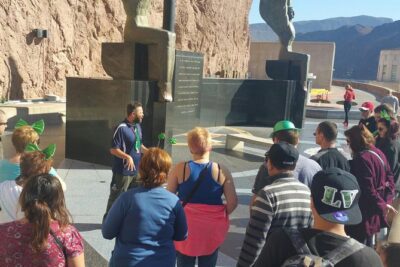
This is the emotional center of the tour. The guide focuses on the takedown of the Red Light District, including an interview about Mrs. Roosevelt’s visit and the role Hoover Dam played in shutting down brothels famous all across the country.
You also learn that this is described as the official location of the first courthouse and post office, and how those civic uses connect to the Red Light District’s demise. The tour frames the story as a shift in legitimacy, governance, and attention, not just a random moral decision.
I like that this stop is treated as more than shock value. The tour builds the facts in a chain: what the area was, who came through, what infrastructure and policy changed, and how the space got redefined. That makes the darker material feel grounded rather than sensational.
One practical note: this is a good time to slow your pace. The street noise can be high, so stand still when the guide speaks and let your eyes focus on the site details.
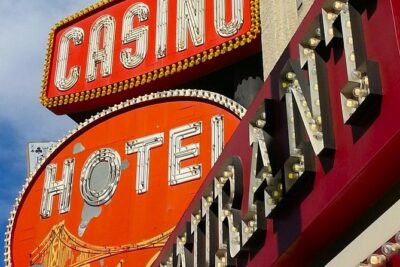
Fremont Hotel: cheap eats history and the shrimp cocktail legend
At the Fremont Hotel casino stop, the tour shifts into a practical mode for the rest of your day. If you are hunting for reasonably priced food on Fremont, this is where you get guidance.
The guide points out food standouts like steak and lobster specials, prime rib, and the legendary shrimp cocktail. There’s also an admission ticket included at this part of the route, which helps the tour feel more like an experience and less like a pure narration.
I found this stop especially useful because it answers the unglamorous question, what do I do after the tour ends? Even if you don’t eat there that moment, you leave with real targets.
El Cortez: Mob-era corridor stories and a secret barber-shop speakeasy
The next stop is the El Cortez Hotel and Casino, described as one of the first Mob hotels, with a hallway of memories and a stop at a secret speakeasy barbershop. The tour ties the El Cortez to the beginning of the Mob era and the beginning of the casino girls.
The guide also explains a detail about how to tell the difference between a working woman and someone who is not. That subject is obviously sensitive, so take the tone as informational and listen for the way the tour frames it in historical context.
I also like that the El Cortez stop has a sensory element. The corridor stories, the “hidden” angle of the barbershop speakeasy, and the way the casino is laid out all make the history feel physical.
Ending at El Cortez and finishing at Container Park: what you do next matters
The tour ends at El Cortez Hotel and Casino, then the experience concludes at the Downtown Container Park on Fremont Street. The guide also provides multiple recommendations for where to go next, including directions to public transportation and a map to museums and points of interest.
That finish is valuable because downtown can feel like a maze if you are new. You are already walking around the Fremont corridor, so getting a clear next step helps you avoid the classic mistake of drifting without a plan.
Also, you get a free bonus download for the Las Vegas Tours – Travel Guide App. That matters because downtown history tends to reward curiosity. If you want to keep the story going after you leave the group, having a guide app handy makes it easier to turn a random afternoon into a structured one.
Price and value: what $52 buys you in the real world
At $52 per person, this tour is not priced like a quick photo walk. It’s priced like a focused, guided route through downtown’s major story locations, with a lot of built-in value.
Here’s why it feels like good value for the money. Most of the stops include admission tickets for the casino locations, so you are not paying extra at each stop. The total time is around two hours, and your guide handles the thread connecting the sites into a coherent narrative, including the Red Light District takedown story.
You also get a tour-sized blend of casino interiors, artifacts, and street-level explanation. If you attempted to do this on your own, you could absolutely visit the casinos, but it would be harder to know what to pay attention to and how the places connect. That “what to notice” guidance is what you are really buying.
If you’re on a tight schedule and want the downtown backstory in one pass, this price can make sense. If you dislike noise and prefer quiet museums, you might want to think twice, because the route lives in an active entertainment zone.
Who this tour fits best, and who might skip it
This is a great match if you:
- like downtown Las Vegas more than the Strip
- want practical context for why the city developed the way it did
- enjoy photo stops with guidance on angles and landmarks
- can handle walking for about two hours in a crowded area
This may be less ideal if you:
- hate loud streets and busy casino interiors
- expect a long bathroom schedule or frequent breaks without asking
- want a strictly light, family-friendly vibe, because the tour includes the Red Light District story and the consequences of policy and infrastructure changes
Should you book? My honest take
Yes, I think you should book it if you want one strong afternoon that mixes Fremont Street energy with real downtown backstory. The standout value is the combination of guided storytelling plus specific on-site photo moments, all while moving efficiently through places you can’t easily connect on your own.
But book with eyes open. Fremont is loud, and some parts of the route are inside active casino spaces. If you come prepared to listen in short bursts and take your time at photo stops, you’ll walk away with a much sharper understanding of how old Vegas became the Vegas people talk about.
If that sounds like your kind of Las Vegas, this one is worth it.
FAQ
How long is the Red Light District & Fremont Street walking tour?
It runs about 1 hour 40 minutes to 2 hours.
What does the tour cost?
The price is $52.00 per person.
Where does the tour start and where does it end?
It starts at Carousel Bar1 S Main St, Las Vegas, NV 89101, and it ends at El Cortez Hotel and Casino, 600 E Fremont St, with the experience concluding around Downtown Container Park on Fremont Street.
Is transportation included?
No. Transportation is not included.
Is the tour in English?
Yes, it is offered in English.
Do I get a mobile ticket?
Yes, it uses a mobile ticket, and confirmation is received at booking time.
Is there anything included with the tour price?
You get an in-person tour guide and a free bonus download for the Las Vegas Tours – Travel Guide App.
What is the cancellation policy?
Free cancellation is available up to 24 hours in advance for a full refund. If you cancel less than 24 hours before the start time, the amount paid will not be refunded.
More Walking Tours in Las Vegas
More Tours in Las Vegas
More Tour Reviews in Las Vegas
Not for you? Here's more nearby things to do in Las Vegas we have reviewed
More Walking Tours
★ 5.0Las Vegas Downtown & Fremont Street – Guided Walking TourFrom $37636 reviews
★ 5.0Hoover Dam with Walk On Top Tour and Seven Magic Mountains StopFrom $78485 reviews
★ 5.0Must-See Spots Vegas Strip Walking TourFrom $49384 reviews
★ 5.0Hoover Dam Walk-On-Top Tour w/ Seven Magic Mountains & Vegas SignFrom $79361 reviews
★ 5.0Arts District Eats: Food, Art & Culture Walking Tour in Las VegasFrom $124191 reviews
★ 4.5Hoover Dam Top-to-Bottom Tour—Dam Walk, Powerplant & River FloatFrom $293155 reviews
★ 4.9Fremont Street Walking TourFrom $37153 reviews
Hoover Dam Bridge Walk + Red Rock Canyon Combo TourFrom $60134 reviews
More ways to spend the day